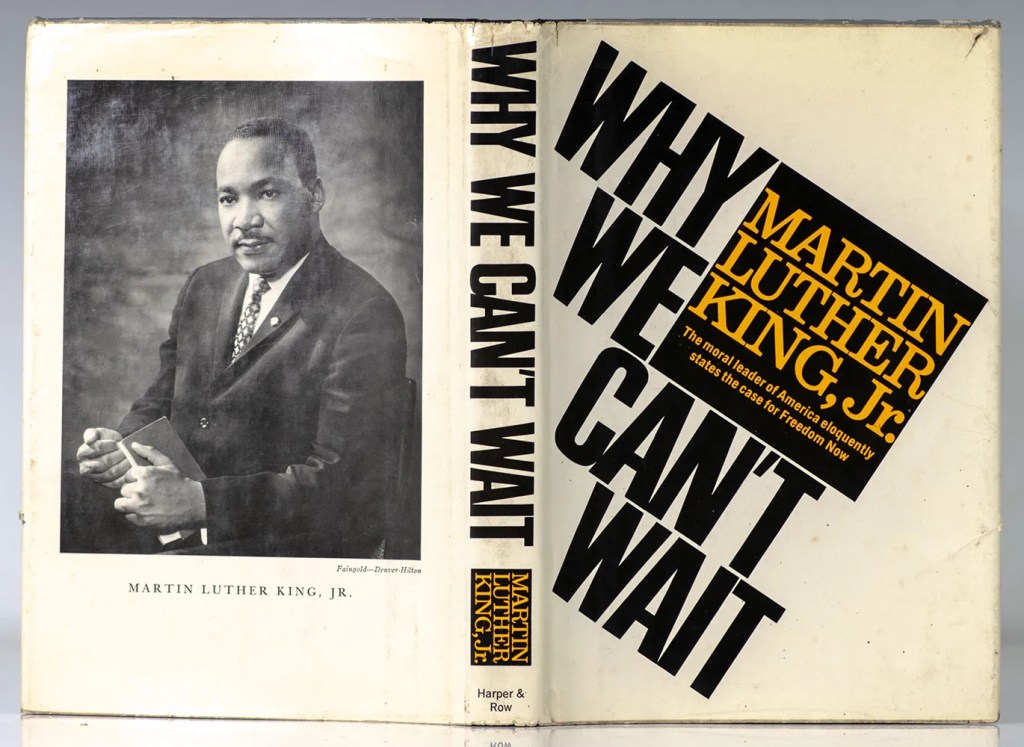
Why We Can’t Wait
“A social movement that only moves people is merely a revolt. A movement that changes both people and institutions is a revolution.”
Martin Luther King Jr.’s legacy is peace. He is almost always referred to in reference to pacifism and peaceful protest. And while he’s referenced in less than a handful of infamous quotes we never address how articulate and eloquent of a speaker he was nor do we acknowledge his strength and intention as a writer.
In Why We Can’t Wait MLK’s infamous prison letters are compiled, but more impactfully King details how the civil rights movement came to be and how intentional the action taken in the late fifties and early sixties was. In his writings King makes known that the summer of protest took deep planning. Years of planning that has yet to be acknowledged by the majority of the public. The civil rights movement wasn’t just a randomly occurring movement, but instead it was a thorough and cohesive plan. King articulates how he traveled through southern states speaking to and recruiting black and white lawyers, educators, and adolescents alike to join in the movement and not into a disorganized series of protests, but instead into a deeply concentrated and organized system of legal and civil society groups throughout multiple states that each played an important role in making the movement. This collection of stories delivers a masterclass in how to organize a movement. From motivating and garnering the support group, to planning efficient and relevant action, and finally making sure this action results in legislative regime change. King’s relevance should heavily focus on the intentionality of this movement juxtaposed with its success. In his descriptions of organizing the movement he specifically details some of his mistakes and findings along the way. One of the most important being his recognition of how resourceful and useful young people could be in the movement. He witnessed how the adolescents and young adults would come in droves from school and work and while educators were originally in his rallying pool this age demographic wasn’t until he saw how passionately they were involved in the movement.
King’s book makes an important point about organizing a successful movement besides the tedious planning. Rhetoric and persuasion. The art of rhetoric and persuasion in writing is rarely taught in depth anymore. We learn egos, logs, and pathos then tread away from the effectiveness and importance of persuasive writing and conversation skills. King’s writing is a prime example of simultaneously elusive and upfront persuasive writing. King makes known why he was organizing the movement and what his goals were on the surface, but through his writing he is shyly and convincingly persuading the audience into believing in the legitimacy of the movements panning out. He is also simultaneously making a second underlying argument to the audience which follows the title note of, Why We Can’t Wait. It is a double entendre that he expertly crafts. We couldn’t wait then, but it’s not called why we couldn’t wait because we are still waiting for equality even post civil rights movement (this book was published the same month the civil rights act was passed). He is persuading behind a second movement of more accessibility and equality for all people, but also more real planning and organized force behind our future movements. It can be seen as a kind of signal that our work isn’t done and the movement should not lose momentum now.
King is one of few authors who can successfully communicate, argue, and persuade in one book and it’s shameful that we don’t talk more about how deliberate he was in his writings, speeches, and in planning the civil rights movement as a whole. He wasn’t just a revolutionary because he was a pacifist who people could rally behind, but instead because he made himself a successful leader and change maker through persuasion and planning. I think it’s important that everyone reads this book for the historical context, relevance, and impressiveness of the civil rights movement and to challenge their own knowledge of King as a leader and what an undertaking the civil rights movement was as a whole, but also to understand the importance and action of being a persuasive writer, speaker, and planner in the modern age of necessary regime change.
Written by Eva Hamilton. Eva Hamilton is a freshman at GW studying data analytics with a concentration in physics and minoring in public policy. She loves to read, lift, and explore astrophysics content in her free time.
 Vocal Chords Journal @ GW
Leave a comment