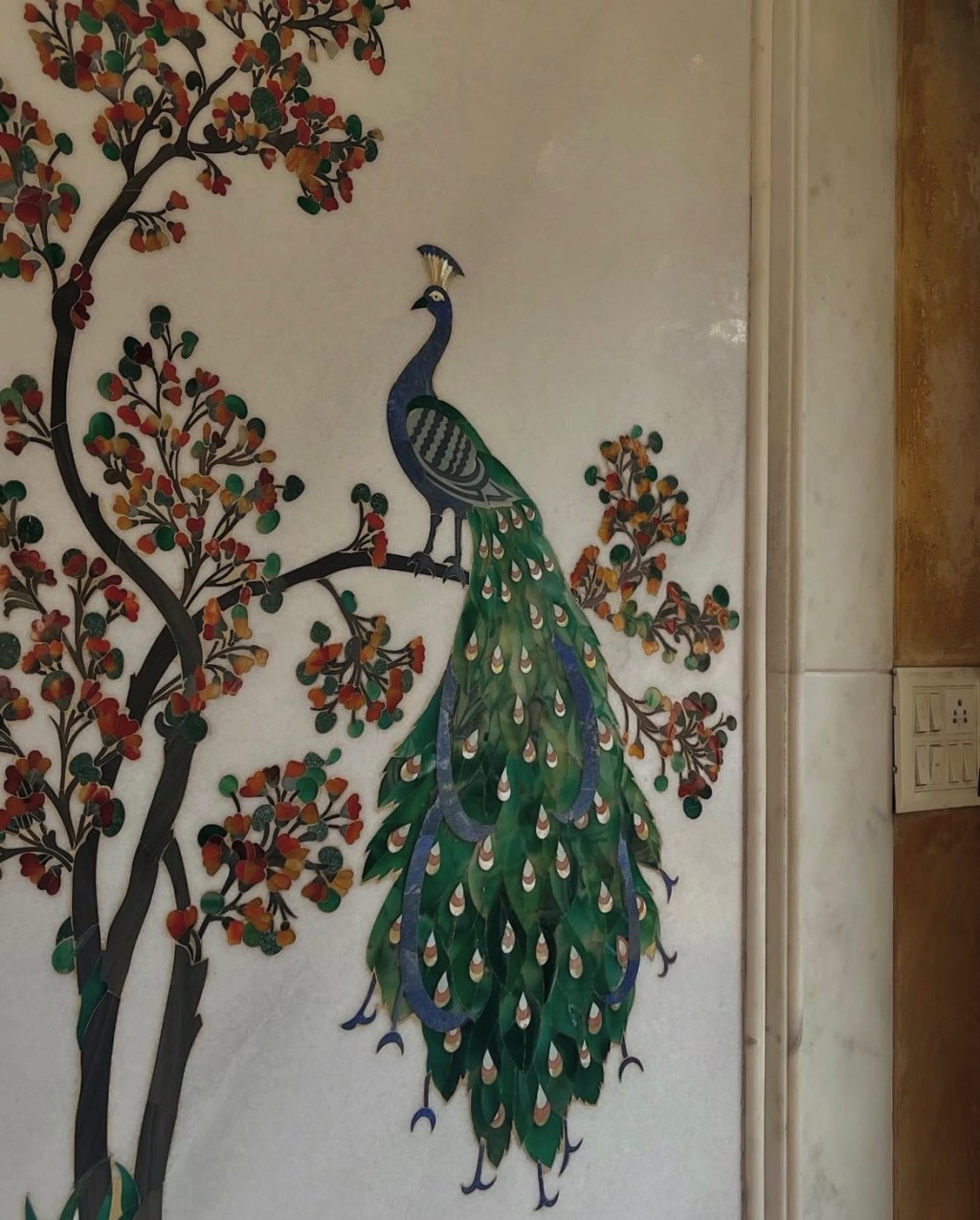
Passed down from mother to daughter for five generations, this Banarasi saree shines with a legacy that is far richer than its golden threads. Zarna Patel, now a Washington D.C. resident, donated her family’s magnificent saree to the George Washington University textile museum. Nearly 120 years ago, this saree was commissioned for the wedding trousseau of Kamlaben Desai, a young bride atthe time from Sojitra (modern-day Gujarat). The adorned garment, with rich navy blue cotton silk and golden peacock motifs, outlived the first woman who wore it and became a cherished heirloom that was passed down throughout the family.
The saree originated from Benares, now known as Varanasi— a major center of silk weaving in Uttar Pradesh, India. Every detail on the saree represents the strength and characteristics of Patel’s family. Patel’s great-grandmother, Kamblaben, initially had her mind set on only wearing black to her wedding. However, her mother forbade it, so instead she had the deep navy saree made for her. The golden peacock motifs in the saree represent grace, prosperity, and fertility: all which translated the hopes they had for the bride, through traditional Indian beliefs The narrative surrounding Indian textiles like the Banarasi saree frames them as exotic and luxurious due to its aesthetic qualities. But now, Western fashion often strips this narrative of its cultural context and reframes it through appropriation, where sarees are cut apart and repurposed to create new pieces. This transforms a sentimental heirloom into a raw material used for fast fashion, devaluing the cultural significance and authenticity behind the saree.
The History of the Banarasi Saree
The Banasari saree’s history is worthy of admiration, dating back as far as the documented history of the region. The sarees are made in the holy city, historically known as Benares (formally known as Varanasi). They are crafted by Tantuvayas, weavers who craft livelihood through weaving cloth. This garment dates back to the Vedic era (1500 BC to 500 BC) where the Vedas valued the precise devotion to weaving in Benares. According to Vinay Kumar Chauhan, a
researcher in Indian handlooms and textiles, he states that “The Vedic book refers to weavers as Tantuvayas, who weave garments of many kinds, including cotton, silk, and brocades..” (Chauhan 15723). The precision that is required in weaving and crafting a Banarasi saree is what makes it so exquisite. The production of these sarees requires a variety of zari, or metallic threads.
Pure zari (also known as “real zari”) is manufactured by looping silver lametta and flat wire over another, or by electroplating gold onto silver zari threads. Tested zari (imitation zari) uses silver and copper lametta to resemble real zari. The weaving process is extremely intricate and includes several design variations and handlooming techniques. Some weaving techniques that are typically used when weaving Banarasi sarees include plain weaving, designing with extra weft, Jala designing, and Jacquard designing. These methods typically rely on the Jala system, which is a tool that translates a motif made on paper into an interlacement of warp and weft using thicker, stronger thread. Weaving a saree requires complex and specialized knowledge on tools like the Jala and pit loom: it requires every little detail to be perfectly set and controlled in order to produce the final delicate design. The historical depth and complexity of the Banarasi saree shows that its value cannot be reduced to short-term trends and luxury. It is produced through generational art and labor, and should function as a cultural archive. Western fashion extracts this value while the original history and weavers are rendered invisible.
Patel’s Banarasi saree serves as a living example of how authenticity and craftsmanship are embedded within traditional Indian textiles. Patel’s saree was made from pure gold zari, which allows for its dazzling effect. The Tantuvaya weaved the zari with the fabric to create the design, or in her case, the peacock motifs. Patel said that the peacock was chosen because it is a “fertility symbol” and it was going to be for the bride. However, the weaving on the pallu, or the loose end on the bottom of the saree, resembles the lattice design that is inside the Taj Mahal. She believes that one of the reasons her saree was selected to be displayed in the George Washington University textile museum was because it is arguably more unique compared to the detailed designs of other sarees. She believes that “when the weavers weave, their intent is different, the salesperson is different, and the artist is different.” When designed, each saree has a specific
intention and artistry behind it. That is what makes Indian traditional wear authentic and artistic while still appearing luxurious.
Another reason she believes her saree was selected was because it was so well-kept and maintained. She had to “..keep it rolled twice a year… take it out, put it in the sun…” and it has “never been polished, ever.” The preservation process was nearly as meticulous as the weaving process. While the identity of the saree weaver is unknown, it’s widely recognized that he chose a specific cotton silk material to keep the product from tearing, understanding its delicacy. Cotton silk cannot be ironed, polished, or steamed otherwise it will be damaged. After tending toward the saree for so many years, Patel demonstrated her deep emotional attachment to the saree by explaining that although she could have sold it many years ago for a significant sum, she chose to keep it because its sentimental value outweighed any monetary worth. It represents and honors her family’s roots, and she decided to part ways with it so at the exhibition, people can see it and enjoy it the same way she has for the past 40 years. By preserving the saree for decades and refusing to sell it despite its high value, Patel reinforces the idea that sarees function as cultural heirlooms rather than commodities of the fashion industry. Her decision to showcase it in an exhibition resists the temptation to follow through with appropriation.
Versatility, Femininity, and Women’s Agency
Other than the saree’s rich cultural significance and artistry, its significance goes far beyond the outer appearance. Liz Mount, a scholar focusing on contemporary Indian womanhood interviewed 31 urban middle-class women for her qualitative study. One of the women she interviewed, Prema, whose last name is not provided in the text, believes that by wearing sarees in settings such as a male workplace, “You were always more respected and felt more dignified..” (Mount 177). Mount positions the garment as encouraging respectability and offering protection from rude comments and the male gaze. The garment not only “covers you up totally but also “if you wear a saree, you get a lot more respect … so that is where the saree holds better for [working women]” (Mount 178). In other words, wearing a saree in professional and social contexts creates more of an authoritative figure and for individuals to listen more attentively and hold more respect. This notion is far more different than Western ideals that approach modesty differently– that covering up is more restrictive rather than empowering. This highlights how cultural context shapes the meaning of dress and agency.
However, Patel has a different view on the relationship between sarees and gender roles. To her, sarees are extremely versatile— you can choose to cover yourself or appear provocative: “So, you know, you have a pallu; you just cover yourself. And you don’t see anything. The men don’t see anything. But on the other hand, if you look at it, I mean, these days I don’t even want to see
what’s happening in India and in Bollywood, because the blouses have gotten smaller and smaller. But if you look at it, your midriff is open, your shoulders are open, your breasts are open; you’re wearing a petticoat, and it can be modest.” The saree embodies femininity in all its expressions, offering protection against the male gaze while honoring the natural beauty of a woman’s body. She also wears sarees on any and every occasion, “So if I go to the temple in India and all, I will always wear a saree out of respect.. And if I’m having a drink at a bar, I
will…wear a very small blouse and a chiffon saree, but it’s still the same. So we can work it out; it’s very versatile.” Not only is it versatile in its fashion, but it serves practicality. For women working in the fields, they were able to carry food in their pallu or hold their children over their shoulders. If it is raining, you are able to cover yourself up. Her fluid approach challenges the idea that sarees enforce gender expectations, but rather should be utilized so women can navigate their identity and respect independently.
Western Appropriation and Culture Erasure
The appeal of the versatility and innovation of traditional sarees has translated into Western clothing production. Recent trends show the recycling and repurposing of traditional Indian silk sarees. This mostly occurs in the Western tourism market, and results in the destruction of the original garment in an effort to create new and “exotic” fashion. This process involves a crucial act of destruction as the sarees are “cut up, destroying both the Indian form of the garment and the structure of patterns across its surface” (Norris 12). The garments that are created out of this process are typically Western-styled clothing such as “shirts, sundresses, skirts, shorts, halter-neck tops, pedal-pushers, and drawstring trousers” (Naik 1512). Once these garments are
cut up, only some may recognize the patterns as being originally Indian. Many will rather recognize them more generically, as “Eastern” or “Asian,” and not provide credit where it is due. The commodification of sarees in Western fashion markets is more than just adaptation or inspiration, and it teeters towards cultural erasure. While the recycling and repurposing of sarees into Western clothing is a form of sustainability, the destruction of the fabric destroys any cultural value it held that came along with it. As Norris notes, the saree’s patterns and structures are intentionally designed to create one, unbroken textile. However, once that is destroyed, the garment loses its artistic and cultural coherence it was originally intended to have. This demonstrates how Western consumption can strip cultural authenticity while selectively benefiting their fashion market, creating a contrast between modernization and the importance of preserving history. In this context, the saree becomes less of a symbol of heritage and rich artistry, and more of a raw material available for consumption without permission or acknowledgement.
Patel believes that the solution to the issue is for younger generations to keep the tradition alive. Despite Western fashion markets stealing and repurposing an Indian art form, it is important that future generations of Indian women continue to keep the tradition alive by wearing sarees. By doing this, the Indian community is asserting their cultural identity and taking back what is theirs. Wearing a saree becomes not only a personal fashion choice, but a political statement to honor the weavers, the art, and the women before who wore sarees. This generates far more symbolic wealth than any profit-seeking industry could make through appropriation. Wearing a saree as an everyday practice and during daily occasions becomes a form of cultural preservation, education about Indian heritage, and can encourage fashion inspiration to others in non-appropriating ways. This ensures that the Indian community preserves the intricate skills, artistry, and stories that are behind Indian traditional wear. Patel emphasizes that pride is central to this resistance and that “there should be no inhibitions in wearing a saree… You can go anywhere. I could go to the government or Parliament and I will still wear a saree. Which is how it should be because I’m an Indian, and I’m proud to wear it.”
Works Cited
Abdul Kadhar Katpadi Mohammed, and Subhas V. Naik. “Development and
Characterization of Handloom Butta Silk Saree Using Spun Silk as Warp
or Weft.” Journal of Natural Fibers, vol. 19, no. 9, 2022, pp. 3333–3339.
Chauhan, Vinay Kumar. “Banarasi Saree a Part of Rich Indian Culture – A
Review.” Journal of Natural Fibers, vol. 19, no. 17, 2022, pp.
15723–15737.
Gupta, Alisha Haridasani. “The Sari as Art, and Political Statement.” The New
York Times, 17 Oct. 2025.
Mount, Liz. “Saris and Contemporary Indian Womanhood: How Middle-Class
Women Navigate the Tradition/Modernity Split.” Contemporary South
Asia, vol. 25, no. 2, 2017, pp. 167–181.
Norris, Lucy. “Recycling and Reincarnation: The Journeys of Indian Saris.”
Mobilities, vol. 3, no. 3, 2008, pp. 415–436.
Vepa Vyas, Shweta. “How to Spot an Authentic Banarasi Sari, According to
Experts.” Vogue India, 17 Jan. 2024.
Janhavee Kulkarni is a freshman at GWU studying economics with a minor in music. She loves music, crafting, being active in her community, trying new coffee shops, and of course, writing.
 Vocal Chords Journal @ GW
Leave a comment